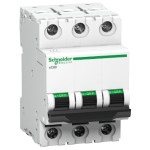
MCB (Miniature Circuit Breaker) — Buy Online at RAS Electrihub India
A Miniature Circuit Breaker (MCB) is an electromechanical protection device that automatically disconnects a circuit whenever it detects an overload condition or a short-circuit fault. Unlike a conventional rewirable fuse, an MCB does not need to be replaced after operation — it can be reset manually and put back into service immediately, making it faster, safer, and far more reliable for protecting electrical circuits in homes, offices, factories, and infrastructure projects across India.
In India, MCBs are governed by IS 60898 (identical to IEC 60898-1) for domestic and commercial applications and IEC 60947-2 for industrial-grade products. They are categorised by their tripping characteristic curve (B, C, D, K, Z), pole configuration (1P, 1P+N, 2P, 3P, 4P), and rated current — ranging from 0.5 A to 125 A. A critical parameter to check before purchase is the breaking capacity (the maximum short-circuit current the MCB can safely interrupt), with standard values of 6 kA and 10 kA for most Indian installations.
At RAS Electrihub, we carry a curated range of MCBs from ten globally proven brands — Schneider Electric, ABB, Siemens, Lauritz Knudsen, Eaton, General Electric (GE), Hager, C&S Electric, Legrand, and Havells — stocked across every pole configuration, tripping curve, and current rating to serve Indian residential, commercial, and industrial buyers from a single trusted source.
MCB Tripping Curves — B, C, D, K, Z: Which One Do You Need?
The tripping curve of an MCB indicates the range of fault current at which the magnetic (instantaneous) trip element activates. Choosing the wrong curve is one of the most common specification errors — a curve that is too sensitive causes nuisance tripping on motor startups, while one that is too slow may allow damage to cables or equipment before it operates. Here is a practical guide for Indian installations:
Curve B MCB — Instantaneous Trip at 3× to 5× Rated Current
Curve B is the most sensitive of the standard curves and operates instantaneously when the fault current reaches 3 to 5 times the MCB's rated value. In India, Curve B MCBs are the correct choice for circuits supplying purely resistive loads — domestic lighting circuits, socket outlet rings in residences and apartments, and circuits feeding sensitive electronic instruments or measurement equipment. They offer the fastest disconnection and are preferred where cable protection with minimal tolerance for sustained overloads is required.
Curve C MCB — Instantaneous Trip at 5× to 10× Rated Current
Curve C is by far the most widely used tripping curve across India — in residential distribution boards, commercial panels, office complexes, hospitals, and industrial sub-distribution. It trips instantaneously between 5 and 10 times rated current, accommodating the moderate inrush currents drawn by fluorescent and LED lighting, split AC units, small three-phase motors, and general power circuits without nuisance tripping. If you are unsure which curve to select for a general-purpose Indian installation, Curve C is almost always the right starting point.
Curve D MCB — Instantaneous Trip at 10× to 20× Rated Current
Curve D MCBs are engineered for loads with very high startup inrush currents — distribution transformers, large DOL motor starters, welding machines, X-ray equipment, and capacitive power supplies where the initial surge current can be 10 to 15 times the steady-state operating current. The delayed instantaneous trip range (10–20× rated current) allows the startup surge to pass without tripping while still offering full short-circuit protection once the inrush has subsided. Widely used in Indian industrial panels, MCC boards, and process plant control cubicles.
Curve K MCB — Instantaneous Trip at 8× to 12× Rated Current
Curve K provides a tighter and more predictable instantaneous trip band than Curve D, making it the preferred choice where precise protection coordination between upstream and downstream devices is critical. Commonly specified in Indian industrial machine tool panels, CNC control cubicles, and motor feeder protection applications where coordination with contactors, overload relays, and upstream MCCBs must be carefully engineered.
Curve Z MCB — Instantaneous Trip at 2× to 3× Rated Current
Curve Z is the most sensitive MCB curve available, tripping at just 2 to 3 times rated current. It is used exclusively for the protection of highly sensitive electronic circuits, semiconductor devices, precision measurement instruments, and PLC input/output circuits where even a small transient overload could cause irreversible equipment damage. Less commonly stocked in India than B, C, and D curves but available from industrial MCB ranges such as Schneider Acti9, ABB S200M, Siemens 5SY, Eaton FAZ, and Hager MTN/MTE.
MCB Pole Configurations for Indian Electrical Installations — 1P, 2P, 3P, 4P
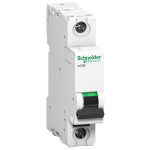
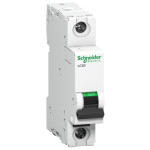
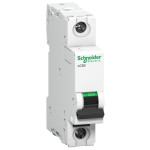
1 Pole (1P) MCB — Breaks only the phase conductor. The most common MCB configuration in Indian homes and offices, used to protect individual branch circuits — lighting points, power socket outlets, ceiling fans, geysers, and single-phase appliance circuits in residential distribution boards and commercial sub-panels.
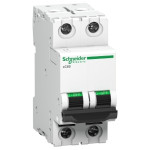
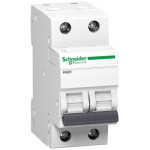
2 Pole (2P) MCB — Simultaneously breaks both the phase and neutral conductors. Required in TT earthing system installations where both conductors must be isolated together, and commonly used as the main incomer MCB for a single-phase metered connection. Also appropriate for DC two-wire circuits in solar PV and battery storage applications.
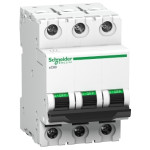
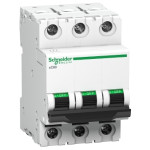
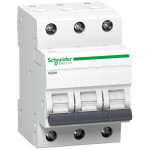
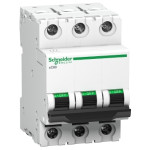
3 Pole (3P) MCB — Breaks all three phase conductors of a three-phase supply without switching the neutral. Specified for three-phase motor circuits, three-phase pump feeders, three-phase sub-main distribution in commercial and industrial panels, and three-phase equipment in factories and process plants across India.
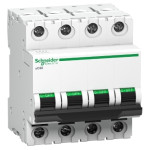
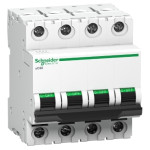
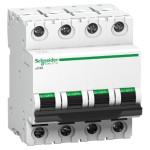
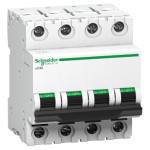
4 Pole (4P) MCB — Breaks all three phases plus the neutral simultaneously. Used at the main incomer position in three-phase + neutral (TPN) distribution boards, generator changeover panels, and industrial main switchboards where complete four-conductor isolation is required. Mandatory in many Indian commercial and industrial project specifications for the incoming feeder position.
MCB Brands & Series — Full Technical Reference Table
Use the table below to compare specifications across every MCB brand and series stocked by RAS Electrihub. Match your required current rating, tripping curve, pole count, and breaking capacity to the right product — then click the series link to view live stock and pricing.
| Brand |
Series / Range |
Current Range |
Curves |
Poles |
Breaking Capacity |
Standard |
Browse |
| Schneider Electric |
Acti9 iC60N / iC60H / iC60L |
0.5 A – 63 A |
B, C, D, K, Z |
1P, 2P, 3P, 4P |
6 kA / 10 kA / 15 kA |
IEC 60947-2 |
View Products |
| Schneider Electric |
Easy9 (EZ9) |
6 A – 63 A |
B, C |
1P, 2P, 3P, 4P |
4.5 kA / 6 kA |
IEC 60898-1 |
View Products |
| Schneider Electric |
Multi9 C60N / C60H |
0.5 A – 63 A |
B, C, D, K, Z |
1P, 2P, 3P, 4P |
6 kA / 10 kA |
IEC 60947-2 |
View Products |
| ABB |
System Pro M Compact S200 |
0.5 A – 63 A |
B, C, D, K, Z |
1P, 2P, 3P, 4P |
6 kA |
IEC 60898-1 |
View Products |
| ABB |
System Pro M Compact S200M |
0.5 A – 63 A |
B, C, D, K, Z |
1P, 2P, 3P, 4P |
10 kA |
IEC 60947-2 |
View Products |
| ABB |
System Pro M Compact S800 |
80 A – 125 A |
C, D |
1P, 2P, 3P, 4P |
25 kA / 36 kA |
IEC 60947-2 |
View Products |
| Siemens |
5SL (SENTRON) 6 kA |
6 A – 63 A |
B, C |
1P, 2P, 3P, 4P |
6 kA |
IEC 60898-1 |
View Products |
| Siemens |
5SY (SENTRON) 10 kA |
0.5 A – 63 A |
B, C, D, K, Z |
1P, 2P, 3P, 4P |
10 kA |
IEC 60947-2 |
View Products |
| Siemens |
5SP (SENTRON) High Breaking |
6 A – 63 A |
B, C, D |
1P, 2P, 3P, 4P |
15 kA / 25 kA |
IEC 60947-2 |
View Products |
| Lauritz Knudsen |
Inpact Series (6 kA) |
6 A – 63 A |
B, C, D |
1P, 2P, 3P, 4P |
6 kA / 10 kA |
IS 60898 / IEC 60898-1 |
View Products |
| Lauritz Knudsen |
BPN / BPP Series |
6 A – 63 A |
B, C, D |
1P, 1P+N, 2P, 3P, 4P |
10 kA |
IS 60898 / IEC 60898-1 |
View Products |
| Eaton |
FAZ (Industrial MCB) |
0.5 A – 63 A |
B, C, D, K, Z |
1P, 2P, 3P, 4P |
10 kA / 15 kA |
IEC 60947-2 |
View Products |
| Eaton |
PL6 / PL7 (Domestic MCB) |
6 A – 63 A |
B, C |
1P, 2P, 3P, 4P |
6 kA |
IEC 60898-1 |
View Products |
| General Electric (GE) |
DPX³ / GB2 Series |
0.5 A – 63 A |
B, C, D |
1P, 2P, 3P, 4P |
6 kA / 10 kA |
IEC 60898-1 / IEC 60947-2 |
View Products |
| Hager |
MBN / MCS Series |
6 A – 63 A |
B, C |
1P, 2P, 3P, 4P |
6 kA / 10 kA |
IEC 60898-1 |
View Products |
| Hager |
MTN / MTE Industrial Series |
0.5 A – 63 A |
B, C, D, K, Z |
1P, 2P, 3P, 4P |
10 kA / 15 kA |
IEC 60947-2 |
View Products |
| C&S Electric |
CSMCB / CSV Series |
6 A – 63 A |
B, C, D |
1P, 2P, 3P, 4P |
6 kA / 10 kA |
IS 60898 / IEC 60898-1 |
View Products |
| Legrand |
DX³ 6000 / DX³ 10000 |
6 A – 63 A |
B, C, D |
1P, 2P, 3P, 4P |
6 kA / 10 kA |
IEC 60898-1 |
View Products |
| Legrand |
TX³ (Value Range) |
6 A – 63 A |
B, C |
1P, 2P, 3P, 4P |
6 kA |
IEC 60898-1 |
View Products |
| Havells |
SPN / TPN Range (6 kA) |
6 A – 63 A |
B, C, D |
1P, 2P, 3P, 4P |
6 kA / 10 kA |
IS 60898 / IEC 60898-1 |
View Products |
All MCBs stocked by RAS Electrihub are certified to IEC 60898-1 or IEC 60947-2 as applicable. Breaking capacity ratings are at 415 V AC. Always verify the individual product datasheet before finalising your selection for a specific installation.
MCB Brands Available at RAS Electrihub — Detailed Brand Guide
Schneider Electric MCBs — Acti9, Easy9, Multi9
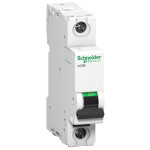
Schneider Electric is among the most widely specified MCB brands in Indian commercial, institutional, and industrial projects. The Acti9 iC60 industrial series is offered in three breaking capacity tiers — iC60N (6 kA), iC60H (10 kA), and iC60L (15 kA) — and covers every standard curve (B, C, D, K, Z) from 0.5 A to 63 A, making it the go-to choice for Indian panel builders supplying MCC and industrial control panels. The Easy9 (EZ9) is Schneider's value-oriented MCB designed for residential and small commercial distribution boards in India, available in B and C curves from 6 A to 63 A. The Multi9 C60 series continues to be used extensively in existing Indian MCC panels, sub-distribution boards, and switchboard retrofits. All three series mount on standard 35 mm DIN rail in the Indian distribution board footprint.
Browse All Schneider MCBs →
ABB MCBs — S200, S200M, S800
ABB's System Pro M Compact MCB family is trusted by Indian consulting engineers, EPC contractors, and panel builders for its consistent quality and comprehensive accessories platform. The S200 (6 kA, IEC 60898-1) offers B through Z curves from 0.5 A to 63 A and is widely used in Indian housing projects, hotels, and commercial distribution boards. The S200M (10 kA, IEC 60947-2) is ABB's industrial-grade MCB for Indian MCC panels and process industry switchboards where higher fault levels demand greater breaking capacity. The S800 handles the 80 A to 125 A current range at up to 36 kA breaking capacity — commonly specified for the main incomer position in large Indian industrial and commercial distribution boards. ABB's 17.6 mm compact module width maximises usable space inside Indian panel enclosures.
Browse All ABB MCBs →
Siemens MCBs — 5SL, 5SY, 5SP (SENTRON)
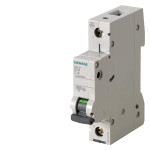
Siemens SENTRON MCBs are a popular choice in Indian infrastructure projects, pharmaceutical plants, data centres, and commercial complexes. The 5SL (6 kA, IEC 60898-1) is a compact residential MCB offering B and C curves from 6 A to 63 A for Indian domestic distribution boards. The 5SY (10 kA, IEC 60947-2) extends the range with K and Z curves for motor protection, sensitive control circuits, and demanding industrial applications from 0.5 A to 63 A. The 5SP high-performance series provides 15 kA and 25 kA breaking capacity for Indian industrial plants, high-rise commercial buildings, and locations with high prospective short-circuit currents close to a substation. The SENTRON platform supports a full range of auxiliary contacts, shunt trip releases, and undervoltage coils for integration into Indian BMS and SCADA systems.
Browse All Siemens MCBs →
Lauritz Knudsen MCBs — Inpact, BPN, BPP
Lauritz Knudsen — formerly the electrical and automation division of L&T, now operating independently — is one of the most trusted MCB brands in the Indian electrical market, with a manufacturing base in India and products carrying the mandatory ISI mark under BIS licence for IS 60898. The Inpact series is their flagship domestic and commercial MCB, available in B, C, and D curves from 6 A to 63 A at 6 kA and 10 kA, and is widely specified in Indian housing projects, apartment complexes, hospitals, and government buildings. The BPN and BPP series introduce the 1P+N pole configuration — a single module that protects both phase and neutral — which is particularly important for Indian single-phase distribution in multi-unit residential buildings where DB space is a constraint. Lauritz Knudsen MCBs carry the ISI mark and are accepted without substitution in CPWD, PWD, NBCC, and state government electrical tenders requiring IS 60898-certified products.
Browse All Lauritz Knudsen MCBs →
Eaton MCBs — FAZ, PL6, PL7
Eaton offers a well-differentiated MCB portfolio for Indian industrial and domestic buyers. The FAZ industrial MCB (IEC 60947-2) is available across the full B, C, D, K, and Z curve range from 0.5 A to 63 A at 10 kA and 15 kA breaking capacities. It is widely used by Indian OEM machine builders, control panel fabricators, and process industry engineers who need precise protection coordination and a wide accessory range. The PL6 and PL7 domestic MCBs (IEC 60898-1) offer B and C curves from 6 A to 63 A at 6 kA — a practical, space-efficient solution for Indian residential consumer units and light commercial distribution panels. Both series mount on standard 35 mm DIN rail and support optional auxiliary accessories.
Browse All Eaton MCBs →
General Electric (GE) MCBs
General Electric MCBs cover B, C, and D tripping curves from 0.5 A to 63 A in single to 4-pole configurations, certified to IEC 60898-1 and IEC 60947-2. GE MCBs are regularly specified in Indian commercial distribution panels, switchboards for EPC-constructed facilities, and industrial installations where an internationally established brand with a global service network is required. Their compact DIN rail footprint and wide accessory compatibility make them a reliable choice for Indian panel engineers working on international turnkey projects.
Browse All GE MCBs →
Hager MCBs — MBN, MCS, MTN, MTE
Hager is a premium European electrical brand with a growing presence in Indian commercial, hospitality, and healthcare projects. The MBN and MCS domestic series (IEC 60898-1) cover B and C curves from 6 A to 63 A at 6 kA and 10 kA, suited for Indian hotel projects, hospital branch circuits, and commercial distribution boards where European brand specifications are required. The MTN and MTE industrial series (IEC 60947-2) extend the range to D, K, and Z curves at up to 15 kA for Indian industrial panel boards and machine protection applications. Hager's 17.5 mm module width integrates natively with Hager's Volta and Gamma distribution board systems.
Browse All Hager MCBs →
C&S Electric MCBs — CSMCB, CSV Series
C&S Electric is a Hyderabad-headquartered Indian electrical manufacturer with over five decades of experience supplying the Indian power sector, infrastructure, and government projects. Their MCBs carry the ISI mark under BIS licence (IS 60898) and are manufactured in India — a key requirement for CPWD, state PWD, RDSS (electricity distribution scheme) projects, and other public-sector electrical tenders in India. The CSMCB and CSV series cover B, C, and D curves from 6 A to 63 A in 1P through 4P configurations at 6 kA and 10 kA breaking capacity. C&S MCBs offer a compelling combination of IS compliance, domestic manufacture, and competitive pricing for large Indian government infrastructure projects.
Browse All C&S MCBs →
Legrand MCBs — DX³ 6000, DX³ 10000, TX³
Legrand is a well-established French electrical brand with a strong presence in Indian premium residential, commercial, and hospitality projects through its wide distribution network and well-known wiring device range. The DX³ 6000 (6 kA) and DX³ 10000 (10 kA) are Legrand's primary MCB ranges certified to IEC 60898-1, covering B, C, and D curves from 6 A to 63 A in all pole configurations. The TX³ is Legrand's cost-effective MCB for standard residential consumer units in India, offering B and C curves at 6 kA. Legrand MCBs integrate seamlessly with Legrand's Practibox, XL³, and Nedbox distribution board systems widely used in Indian residential and commercial projects.
Browse All Legrand MCBs →
Havells MCBs — SPN, TPN Range
Havells is one of India's largest and most recognised electrical brands, with MCB manufacturing facilities in India and products carrying the ISI mark under IS 60898 — the mandatory certification standard for MCBs in the Indian domestic market. Their SPN (single-phase) and TPN (three-phase) MCB range covers B, C, and D curves from 6 A to 63 A in 1P through 4P configurations at 6 kA and 10 kA breaking capacities. Havells MCBs are widely available through Indian electrical retail and wholesale channels across the country, making them one of the easiest brands to source for Indian housing projects, builder projects, and government-approved housing schemes. Their after-sales service network spans every major Indian city and town.
Browse All Havells MCBs →
Where Are MCBs Used in India?
Residential Distribution Boards (DBs) — Every Indian home with a metered electrical connection has a distribution board fitted with MCBs to protect individual branch circuits — lighting, fans, air conditioners, geysers, kitchen appliances, and socket outlets. For standard Indian homes, a Curve C, 6 kA, 1P MCB is the default specification for most branch circuits, with a 2P or 4P incomer MCB at the main position.
Apartment and Housing Complex Sub-Boards — In Indian multi-storey apartment complexes (particularly under RERA-registered residential projects), each flat is served by its own distribution board with 1P MCBs for branch circuits and a 1P+N or 2P MCB as the flat incomer. The building common areas, lifts, pumps, and DG sets are protected by 3P and 4P MCBs in common service panels.
Commercial Buildings — Offices, Malls, Hotels, Hospitals — Commercial distribution panels in India require higher breaking capacity MCBs (10 kA, Curve C or D) to handle the higher fault levels at the main LT switchboard. Three-phase and four-pole MCBs are used extensively for HVAC distribution, power sockets, lighting panels, and fire-fighting pump feeders in Indian commercial buildings.
Industrial Panels, MCCs, and Control Cubicles — Indian manufacturing plants, process industries, and power plants use IEC 60947-2 industrial MCBs (10 kA+, Curves C, D, K, Z) in Motor Control Centres, machine panels, PLC panels, and instrument distribution boards to protect motor feeders, control transformers, and sensitive electronic circuits.
Solar Rooftop and Renewable Energy Installations — DC-rated MCBs protect individual solar PV string circuits and combiner box outputs, while standard AC MCBs protect inverter output circuits, metering panels, and export limit connections in Indian grid-connected solar rooftop projects under the PM Surya Ghar Muft Bijli Yojana and state DISCOM net metering programmes.
Government and PSU Projects — CPWD, PWD, RDSS, Smart Cities — IS 60898-certified, ISI-marked MCBs from Indian manufacturers (Havells, C&S Electric, Lauritz Knudsen) are mandatory for all central and state government electrical projects in India. RAS Electrihub stocks ISI-marked MCBs across all three brands in full, and can supply against government purchase orders and GeM portal procurement.
MCB Selection Guide for Indian Installations — 5 Steps
Step 1 — Calculate the circuit full-load current and size the MCB rating
The MCB rated current must be higher than the circuit's steady-state full-load current, but must not exceed the current-carrying capacity (CCC) of the installed cable. Size to the cable, not just the load. Typical Indian circuit ratings: 6 A for lighting points, 16 A for 5-pin power sockets, 20 A for 1.5-ton split ACs, 32 A for geysers and 2-ton ACs, 40–63 A for sub-main feeders.
Step 2 — Select the appropriate tripping curve for the load type
For Indian residential lighting and socket circuits, use Curve B or C. For general commercial distribution, split ACs, fluorescent lighting, and small pumps, use Curve C — this is the standard specification for the vast majority of Indian distribution boards. For large motor starters, transformer primaries, welding machines, and UPS systems, use Curve D to avoid nuisance tripping on startup inrush.
Step 3 — Choose the correct number of poles for the circuit and earthing system
Single-phase branch circuits in India — use 1P. Main incomer to a single-phase distribution board — use 2P. Three-phase motor or equipment feeder — use 3P. Main incomer to a three-phase + neutral (TPN) distribution board or changeover panel — use 4P.
Step 4 — Verify the breaking capacity against the prospective fault current at the installation point
For standard Indian residential distribution boards fed from an 11 kV/415 V distribution transformer at 100 kVA to 400 kVA, a 6 kA breaking capacity MCB is generally sufficient for branch circuits. For the main incomer MCB of a residential DB, and for all positions in commercial and industrial panels close to the LT switchboard or transformer secondary, a 10 kA breaking capacity MCB should be specified. Always ask your electrical consultant or DISCOM to confirm the actual fault level at the point of supply before specifying.
Step 5 — Confirm the applicable Indian standard and ISI requirement
For residential and commercial distribution boards in India, MCBs must comply with IS 60898 (equivalent to IEC 60898-1) and carry the ISI mark where required by the project specification or procurement order. For industrial panels, MCCs, and control boards, specify MCBs to IEC 60947-2. For government-funded or public-sector projects, always confirm the applicable BIS licence requirement — ISI-marked products from Indian-certified manufacturers are mandatory.
Frequently Asked Questions About MCBs in India
What is the difference between an MCB, RCCB, and MCCB?
An MCB (Miniature Circuit Breaker) protects against overload currents and short-circuit faults in the wiring — it is the primary overcurrent protective device in any Indian distribution board. An RCCB (Residual Current Circuit Breaker) — also called ELCB in India — protects people against electric shock caused by earth leakage current but does not provide overload or short-circuit protection on its own. An MCCB (Moulded Case Circuit Breaker) serves the same function as an MCB but at higher current ratings (63 A to 1600 A), with adjustable protection settings, and is used as the main incomer or sub-main breaker in larger Indian distribution systems. In a complete Indian distribution board, all three devices are often used together to provide full protection.
What does Curve B, C, and D mean on an MCB and which should I use?
The tripping curve defines the range of fault current at which the MCB's instantaneous magnetic trip operates. Curve B (3–5× rated current) is for resistive loads and sensitive electronics. Curve C (5–10× rated current) is the standard choice for Indian homes, offices, and general industrial distribution — it handles the inrush currents of most common loads without nuisance tripping. Curve D (10–20× rated current) is for high-inrush loads such as transformers, large motors, and UPS systems. When in doubt for a standard Indian installation, select Curve C.
What breaking capacity MCB should I buy for my Indian home or office?
For a standard Indian residential home or apartment served by a 100–400 kVA distribution transformer at the end of an LT feeder, a 6 kA breaking capacity MCB is adequate for branch circuits. For the main incomer position of the home DB, and for any commercial or industrial panel where the supply is taken directly from a dedicated transformer feeder or close to an LT switchboard, specify 10 kA. If you are unsure, ask the DISCOM or your electrical contractor to provide the declared fault level at your point of supply.
Are MCBs sold by RAS Electrihub ISI marked and BIS certified?
Yes. All MCBs sold through RAS Electrihub are certified to the applicable Indian or international standard. MCBs from Havells, C&S Electric, and Lauritz Knudsen are manufactured in India and carry the ISI mark under BIS licence for IS 60898 — mandatory for MCBs sold in the Indian domestic market. MCBs from Schneider Electric, ABB, Siemens, Eaton, Legrand, Hager, and GE are supplied through authorised Indian distribution channels and comply with BIS import regulations for switchgear products. We do not source from unauthorised channels or grey markets.
Can I use a 16 A MCB to protect a 16 A circuit in India?
A 16 A MCB is correctly rated for a 16 A circuit only if the installed cable also has a current-carrying capacity of at least 16 A. In Indian practice, a 16 A MCB protecting a 5-pin power socket circuit must be paired with a minimum 2.5 sq mm copper conductor cable (standard in India for power sockets). The MCB protects the cable — if the cable is undersized for the MCB rating, the cable will overheat before the MCB trips. Always size the MCB to match the cable's CCC, not just the socket or appliance rating.
What is a 1P+N MCB and why is it widely used in Indian apartment distribution boards?
A 1P+N MCB is a single-module device (18 mm wide on DIN rail) that provides simultaneous overcurrent protection on both the phase and neutral conductors of a single-phase circuit. It is particularly useful in Indian apartment distribution boards where BEE and NBC (National Building Code) guidelines recommend protecting both phase and neutral, but the DB enclosure has limited DIN rail space. Instead of a separate 2P MCB occupying 36 mm, a 1P+N MCB achieves the same function in 18 mm. Widely used in flat sub-boards in Indian multi-storey residential developments.
What is the difference between IEC 60898-1 and IEC 60947-2 MCBs — which is right for an Indian panel?
IEC 60898-1 (IS 60898 in India) applies to MCBs for household and similar fixed installations — these have fixed, non-adjustable protection settings and are type-tested to a set of standard breaking capacities (4.5 kA, 6 kA, 10 kA). IEC 60947-2 is the industrial standard — MCBs tested under this standard undergo more stringent short-circuit testing at higher breaking capacities (10 kA, 15 kA, 25 kA or above), support a wider range of auxiliary accessories, and are designed for integration into industrial switchgear assemblies. For residential and commercial distribution boards in India, IS 60898 / IEC 60898-1 products are correct. For MCC panels, industrial control panels, machine boards, and process plant switchgear, always specify IEC 60947-2 MCBs.
My MCB keeps tripping — what should I check before resetting it?
When an MCB trips, its handle moves to a middle position between ON and OFF. Before resetting, switch it fully to OFF, then investigate the cause. Check for overloaded circuits (too many high-wattage appliances on one branch), damaged wiring or loose connections causing arcing, or a faulty appliance causing a short-circuit. If the MCB trips immediately after resetting, the fault is still present and must be rectified by a qualified electrician before the circuit is re-energised. Repeatedly resetting an MCB without fixing the underlying fault is dangerous and can damage equipment or start a fire.
Popular Searches in MCB
Schneider MCB 63 Amp |
Schneider MCB 32 Amp |
Schneider MCB 4 Pole |
Schneider MCB 16 Amp |
Schneider MCB 40 Amp |
Schneider MCB 3 Pole |
Schneider MCB 20 Amp |
Schneider MCB 2 Pole |
ABB MCB 40 Amp |
ABB MCB 32 Amp |
ABB MCB 63 Amp |
ABB MCB 16 Amp |
ABB MCB |
Schneider MCB |
Eaton MCB |
Siemens MCB 16 Amp |
Siemens MCB 40 Amp |
Siemens MCB 20 Amp |
Siemens MCB 63 Amp |
ABB MCB 1 Pole |
ABB MCB 2 Pole |
ABB MCB 3 Pole |
ABB MCB 4 Pole |
Siemens MCB 3 Pole |
Siemens MCB 2 Pole |
Siemens MCB 4 Pole |
Siemens MCB 1 Pole |
Schneider MCB 1 Pole |
Schneider Acti9 MCB |
Schneider Easy9 MCB |
Schneider Multi9 MCB |
Schneider Square D MCB |
Lauritz Knudsen MCB 1 Pole |
Lauritz Knudsen MCB 2 Pole |
Lauritz Knudsen MCB 3 Pole |
Lauritz Knudsen MCB 4 Pole |
Lauritz Knudsen MCB 16 Amp |
Lauritz Knudsen MCB 32 Amp |
Lauritz Knudsen MCB 20 Amp |
Lauritz Knudsen MCB 63 Amp |
Schneider C Curve MCB&l